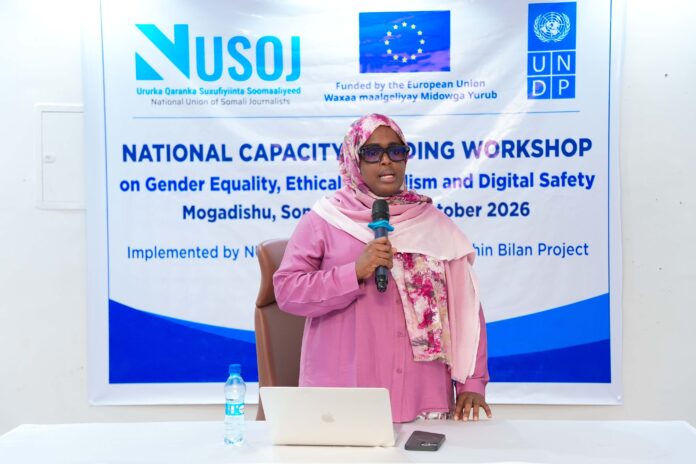
The National Union of Somali Journalists (NUSOJ) has completed two capacity-building workshops in Mogadishu and Galkayo, helping journalists strengthen their skills in ethical reporting, gender equality and digital safety as part of wider national efforts to strengthen women journalists’ leadership, safety and equal participation in Somalia’s media sector.
Held between 25 and 29 October, the workshops brought journalists together to discuss professional standards and the conditions needed for safer, fairer and more gender inclusive newsrooms. The activities were supported by the United Nations Development Programme (UNDP) through the Bilan Project and funded by the European Union (EU).
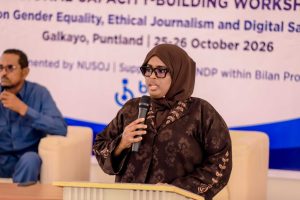
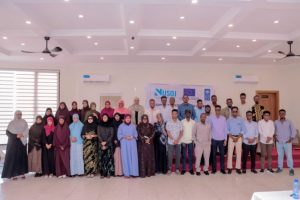
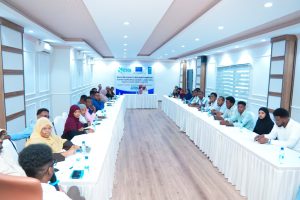
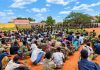
A total of 69 journalists took part: 35 women and 33 men, nine more than the target of 60. The Galkayo workshop, held on 25-26 October, brought together 35 journalists, including 18 women and 17 men. Participants came from Puntland and Galmudug, as well as towns and districts including Garowe, Qardho, Galkayo, Adado, Abudwak, Guriel and Dhusamareb.
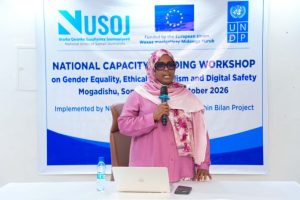
The gathering gave journalists from the two federal member states an opportunity to share experiences, discuss common challenges and forge professional solidarity. The Mogadishu workshop, held on 28-29 October, had 34 participants, including 16 women and 18 men.
“Journalists can serve the public best when they work safely, uphold ethical standards and are treated fairly. These activities sharpened the practical skills and allowed working journalists a safe space to discuss discrimination, digital threats and the barriers facing women in the media. We want these discussions to lead to more respectful newsrooms where women and men can contribute equally and work with dignity and in safety,” said Nima Hassan Abdi, NUSOJ organising secretary.
Participants discussed how ethical and gender-sensitive reporting can build public trust and improve coverage of women and other groups. Sessions covered verification, balanced reporting and avoiding inflammatory language. They also examined the role of newsrooms in upholding professional standards, fulfilling their duty of care and addressing ethical concerns.
The digital safety discussions addressed online harassment, cyberbullying, threats and the misuse of digital content, including AI-generated sexualised images. Participants considered how to protect themselves, their work and their sources, and called for media organisations to respond more effectively to digital abuse.
Presentations, case studies, group work and round-table discussions gave participants the chance to relate the issues to their own professional experiences. In Galkayo, the governor of the Mudug Region, Abdiweli Jibril Beyle, officially opened the workshop and welcomed the initiative.
The workshops strengthened exchange among journalists from different media organisations and locations. They form part of NUSOJ’s wider efforts to improve working conditions and advance women journalists’ leadership, safety and equal participation in Somalia’s media sector.